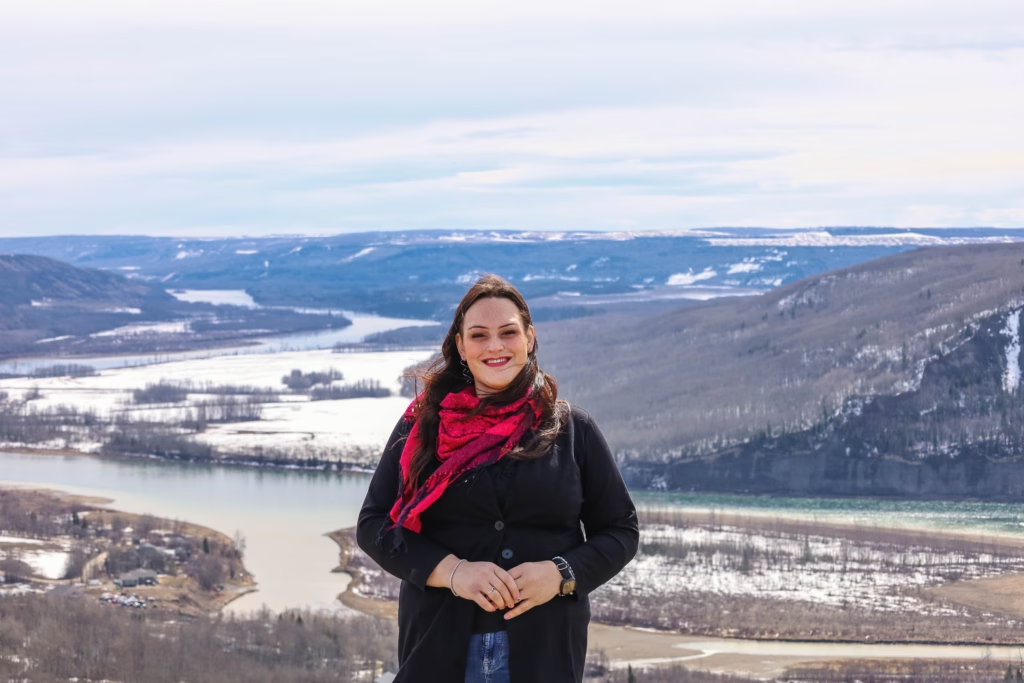

My first connection to the Law Foundation began more than 20 years ago, when I was in law school and serving on the executive of several student clubs and organizations. I prepared proposals and completed interim, financial, and final reports for initiatives that created educational and memorable experiences for law students. These included the Aboriginal Cultural Awareness Camp, Equity Conference, and support to attend and host the Black Law Students’ Association conference. Through those early experiences, I came to see the Law Foundation as an important source of support for legal community initiatives.
At the time, however, I did not fully understand the Foundation’s role in collecting and distributing interest on lawyers’ trust accounts in the province to support legal education, law libraries, legal research, legal aid, and law reform. Although I became more familiar with its work over time through annual reports and funding priorities, it was not until I joined the Racial Justice Grants Advisory Committee in 2023 that I truly appreciated both the breadth of its mission and the intentional way it engages communities in its grant-making.
I was honoured to be appointed to the Board of Governors later that same year, and now, as Chair, I have an even deeper appreciation for the responsibility of stewarding the Foundation’s resources with care and purpose. I bring to this role more than 16 years of experience in private practice and the public sector, along with governance experience as a board member, adjudicator, and volunteer, as well as firsthand experience applying for grants.
What stands out as an achievement in 2025 is the significant increase in funding for front-line direct legal services – the legal clinics and legal advocacy network in BC. The need for civil legal aid services continues to grow, especially in communities that are further away from large cities. Many people are facing challenges to fair access to the justice system, and in many communities, there has been a struggle to maintain adequate availability of legal services across many different areas of law.
“In 2024 and 2025, we invested in significant expansions of the legal clinics serving the Okanagan and Thompson regions in Kamloops and Kelowna.”
Consistently over the past several years, the lion’s share of the Law Foundation’s investments have been under our mandate area of legal aid. This mandate area includes any type of legal assistance or legal services, provided free for clients. Last year, 50% of our funding went to free legal services and support for low-income people in civil and family matters, which amounted to over $37 million. This year we brought that amount to $45 million.
The increased funding means that community legal clinics can offer expanded services that are well-networked and well-supported – we have invested in building the province-wide support infrastructure for these services. Two supports made possible through the Law Foundation’s funding are the Family Advocate Support Line and the Community Advocate Support Line. These are services staffed by lawyers who are experts in family law and a range of other administrative law areas that intersect with the lives of low-income people. They provide timely legal advice for legal advocates who are navigating complex cases. This is just one example of the way increased investments in free legal services can strengthen communities.
In 2025 we focused on funding expanded services in the north, the Interior, and the Lower Mainland. In 2024 and 2025, we invested in significant expansions of the legal clinics serving the Okanagan and Thompson regions in Kamloops and Kelowna. In the coming year, investments are planned to deepen the legal services available to people in the Kootenays and in central Vancouver Island. Early 2026 saw the launch of the new Northern Access Legal Clinic in Prince George.
“For the eight clinics that were started in a funding partnership with the province of BC, the Law Foundation decided to assume full funding responsibility in 2026.”
For the eight clinics that were started in a funding partnership with the province of BC, the Law Foundation decided to assume full funding responsibility in 2026. This will enable the Ministry of Attorney General to use that funding for other important justice priorities. And for the legal clinics themselves, the consolidation of funding sources will make the financial administration significantly more straightforward and less time-consuming, permitting them to focus more time and resources on their core missions.

The work of the Law Foundation of BC, as an independent funder, helps to narrow the gap on access to justice for people who are disadvantaged in BC. We do this independently and without relying on public finances, something we feel good about and will continue to steward with clarity.
I would like to recognize colleagues who have left the Board and express my gratitude for their exceptional service: Mary Childs, KC and Zara Suleman, KC. Mary, former Chair of the Law Foundation, and Zara, former Chair of the New Grants Committee, brought trusted leadership, sound judgment, and support to staff, committee members, stakeholders, and their fellow Board members. Their insight and steady guidance helped shape the Foundation’s work and deepen its impact. The Law Foundation has benefited greatly from their thoughtful leadership and commitment.
— Karen Ameyaw, Chair
(written in June 2026)